Monday, September 30, 2013

Maniac Butcher - Barbarians (1995)


Maniac Butcher is a somewhat obscure band from the Czech Republic. Their earliest demos consisted of fairly average Death Metal, having nothing to do with bands like Master's Hammer or Root. Eventually, it appears that they became inspired by the Norwegian Black Metal scene and changed their style. Their 1995 debut album, Barbarians, is a solid offering of uncompromising Black Metal and, despite the utterly ridiculous cover, it is well worth listening to.

Musically, one can hear a lot of Mayhem and Darkthrone influence in the riffs. Much of the material is based on the stripped down style of the early '90s, with fast and cold tremolo riffs over fast drums. The percussion is a little too active, far from the minimalism of Fenriz, though the playing is very tight and accurate. Still, this changes the feeling a little bit and is often one of the issues when a band has shifted to Black Metal from Death Metal. Though many of the songs are fast and intense, Maniac Butcher has no problem to slow things down on occasion and including kind of doom-oriented riffs that seem to hearken back to their demo days. There are some moments where they seem to channel Celtic Frost and even Master's Hammer, and prove to be quite skilled when it comes to including rather memorable solos. In fact, there are a couple used even during faster parts. Here and there, one is even reminded of early Emperor, minus the irritating keyboards. Instead, these guys relied on traditional instruments and strong songwriting in order to create the hellish and black atmosphere found on this album. The vocals are completely inhuman, sounding much more like a rabid animal. This helps to bring a sense of urgency to the music, especially with the frenetic drumming and fast-picked riffs. There is an epic quality to some of the melodies and you really get the feeling that nothing here is done just for the hell of it. Every idea has some meaning and manages to create a dark or menacing vibe. Some of the most memorable riffs are on "Druhé Stvoření", which are somewhat similar to Darkthrone's "Quintessence" (released that same year), though executed differently and including a rather haunting solo. In fact, this may be one of the best songs on here, showcasing the various elements of the band's sound.

The production is fairly decent. This obviously does not have a plastic, modern sound. Still, the drums are a little too clear and some parts are mixed a bit higher than they should be. It is not a severe problem, but it does take away from the riffs, slightly. As for the guitars, the tone is raw and cold and pretty standard for the time period. It could have benefited from being a little more harsh, but there is nothing really wrong with it as it is. The vocals are easily heard and don't seem to have much effects, such as reverb. The sound is very dry and strained.

Barbarians is a very solid album of Czech Black Metal. More than just another band that were quick to embrace and replicate the northern style, Maniac Butcher proves very capable of creating a strong, dark atmosphere. The only real complaint is that the album is so short, lasting just half an hour. Such would be tedious if the band was only churning out tenth-rate music, but this is too good to end so soon. If you haven't heard this band, it is recommended that you seek this out.

Sunday, September 29, 2013

Forest - Обрекая Надежду На Вечность (1998)


The third full-length album from Forest, Обрекая Надежду На Вечность, was released in 1998. This record contains nearly an hour of cold and dismal Russian Black Metal, with a very minimalist style that owes a lot to the northern sound of the early '90s.It is preceded and followed by very strong albums that may overshadow it, to some extent, yet it should not be ignored for it is also a very worthy recording.

There is a very raw quality to this music. Something immensely genuine and poignant. The style itself has been done by many bands, some with more success than others. However, Forest is one of the few that really gets it and understands the true essence of Black Metal. One is reminded of Filosofem, from Burzum, during the somewhat lengthy intro track that features various tremolo melodies bereft of drums or vocals. The desolate feeling is carried on throughout the songs that follow. The percussion rumbles along at a fast pace, while the cold riffs and hate-filled vocals create an atmosphere of gloom and misanthropy. This is best captured by some of the screams in "Горю...". It is easy to perceive the sense of isolation, physically and spiritually, with the modern world and what is often mistaken for life. Even the lyrics convey this sentiment of being at odds with the world, connecting more with the purity and lifelessness of the winter and death, itself. The vocals are very harsh and contrast the beauty of the guitar melodies, repetitive and trance-inducing as they are. The pace remains the same, throughout the album, yet the various melodies are distinct and memorable. It definitely owes a lot to Darkthrone's Transilvanian Hunger and, though not quite as dark, seems very much like what Fenriz and Nocturno Culto would have come up with if they'd continued with that style. The last two tracks are completely different, however, being more atmospheric in nature. After an instrumental that is not too far removed from what was heard on the second Branikald album, there is a lengthier piece that is composed of many dissonant chords and clean chanting in the background. In its own way, this also hearkens back to Filosofem.

The production is very good, especially compared to the Branikald releases from 1998. The sound is raw and under-produced, with a thin and sharp guitar tone. Yet, in a way, it still comes across as a little more forceful and clear than the aforementioned recordings. The vocals are mixed perfectly, never getting out of control and overpowering the rest. Similarly, the drums are balanced and certainly loud enough to keep a good pace, but are rather dull and not so clear or loud as to distract from the guitars.

Обрекая Надежду На Вечность has to be one of the most solid Black Metal albums to emerge that whole year. At a time when bands like Darkthrone and Gorgoroth were in hibernation or long past their prime, and the likes of Dark Funeral, Emperor and Marduk were receiving so much attention for records that were lame and unworthy, Forest was keeping the true flame of Black Metal burning throughout the dark times of the late '90s. This is very much recommended.

Thursday, September 26, 2013

Branikald - Жизнеотрицанью жизневероломство (1998)


Жизнеотрицанью жизневероломство was released in 1998, the same year as Хмель Мизантропии. The sound is much the same, and anyone familiar with Branikald's albums up to this point would not be surprised. This L.P. features the same stripped-down, raw Black Metal that could be heard on its predecessors. While not as good as a release such as Kveldulv, or as inspired as the Forest albums that were being recorded around the same time, it is not bad.

The production is one of the weak points of the album. It is not so terrible, really, but has the feeling that it is missing something. The guitar tone is not sharp enough. This was an issue on Хмель Мизантропии, as well. Again, this recording has the feeling of being a tenth-generation dub, with a cloudiness that somewhat neuters the songs. This only really affects the instruments, though, as the vocals are still rather prominent in the mix. This has been the case with several of Branikald's albums, as it appears that Kaldrad did not fully appreciate the more subtle approach as found on Рдяндалир, for example. For some reason, this album also has a couple tracks that sound like they were recorded during a different session, with completely different production. The vocals are much more harsh and the guitar tone is more harsh. If not for the loud drums, this would be much more ideal than the sound of the rest of the album.

The songwriting is solid. Of course, if you are even remotely familiar with Branikald's music, then you will know to expect a very minimalist approach. The songs are composed of cold, sombre tremolo melodies that flow over monotonous drumming, while Kaldrad's hateful vocals spew forth in the forefront. The songs are very much in the style of old Darkthrone, though lengthier and more hypnotic, possessing a quality somewhat reminiscent to the faster melodies found on older Burzum albums.  Despite averaging around nine or ten minutes long, these songs never get boring. There are not a lot of dynamics to speak of, outside of rare moments where things die down and dismal guitar chords ring out into the darkness, such as the ending to "Духа Уста Опаляя". As with the last couple releases, the vocals have somewhat too much reverb, not nearly as suitable as the style utilized on the earlier albums, or on the Forest material. The riffs work well to create a dismal feeling, with several introspective melodies that rise up, from time to time. Some passages go on slightly longer than necessary, before getting on to the next interesting idea. "Страстью Cтремимым" stands out, being mid-paced and possessing an entirely different production than the preceding tracks. The vibe is much more harsh and miserable.

Жизнеотрицанью жизневероломство is another solid dose of raw and minimalist Black Metal that is recommended for anyone into the early material from Darkthrone and Burzum. Branikald is one of the few bands to really do justice to this style, keeping to the traditions while adding something as well. Though the vocals are a little irritating, the music is worth giving the time to get used to this peculiarity.

Monday, September 23, 2013

Forest - Песнью В Жатве Горя (1999)


Released in 1999, Песнью В Жатве Горя is considered to be the last true Forest album. This picks up from where its predecessor left off, delivering more raw and minimalist Black Metal with somewhat of an ambient feel. Born during a time when the more popular bands in this field were those that embraced the foul and disgusting modern techniques, this is an album that remained true to the northern style that had developed some years earlier. This is pure and genuine Black Metal, bereft of any occult posturing or outside influences.

The music contained on this album is truly cold and grim, in ways that most bands simply fail to even comprehend. One need not spend years studying scripture and working as much Judeo-Christian mythology into the lyrics as possible to capture the true essence of Black Metal. No outlandish interviews proclaiming this band to be the only ones to really understand the music or any sort of other preposterous antics. The songwriting captures the desolation and solitude of the human spirit as it writhes in the captivity of this modern world, separated from anything that was once pure and meaningful. Even from the intro alone, which is seven minutes of cold guitar melodies, one can sense this. As the first proper song gets underway, there is an added feeling of melancholy conveyed by the brilliant tremolo riffs. Such simple arrangements, yet the feeling is powerful and moving. Drums rush forth at a steady pace, just to keep time and never really drawing much attention. The sombre and frigid guitars flow from one idea to the next, seamlessly. Unlike their first release, this is somewhat one-dimensional in that all of the songs consist of fast tremolo riffs, without any sort of experimentation. Yet, despite the similarity between all of the tracks, each one possesses its own feel. Aside from the style, some of the melodies of "Жаром Вен" will remind one of early Darkthrone, though somewhat gloomier. There is an epic quality to this material, something few others really accomplished with this sound. This is quite clear on "Лей, Кровавая Пенa", which is sorrowful and hateful at the same time, with a main theme that will seep into your mind and drown it in darkness. The music has a hypnotic effect, putting you in a state of consciousness that is more conducive to deep thought. 

The production is just what one would want from this kind of music. The guitar is raw and cold, enabling the riffs to have the desired effect. They are clear enough for one to really become immersed in the melodies, though still fuzzy and harsh. The drums know their place, neither buried nor at the forefront, audible enough to keep the pace and add a bit of urgency to the sound, but never being overbearing in the slightest. The vocals are distant and less forceful. This is how Black Metal should sound. There is somewhat of a necro quality to this, though it is never such that one cannot follow what is going on. Though raw and under-produced, there is still a certain level of clarity.

Песнью В Жатве Горя is a recommended piece of Russian Black Metal that should appeal to purists of the early-'90s sound. But moreso than just keeping the tradition alive, Forest took that approach and made something that possesses its own feeling. In the years before bands like Horna really found their footing, or the likes of Clandestine Blaze or Sargeist came along to keep the pure Black Metal feeling alive, bands such as Forest and Branikald were doing their part to prevent the fires from burning out.

Sunday, September 22, 2013

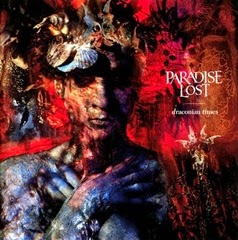
Paradise Lost - Draconian Times (1995)


With their fifth full-length, Paradise Lost managed to find success in failure. Released in June 1995, Draconian Times continued the unfortunate progression of a band that had started out with such promise. This record was the point where the band really settled into their cleaner style, rather than sounding as awkward as they did on Icon. Yet this came at a price, for the music became even more watered-down to a point.

The songwriting is really troubling for those that appreciated the earlier works of Paradise Lost. There are a few traces of doom left, but it has mostly been replaced by goth rock that has a distinctively pop-oriented feeling during much of its forty-eight minute running time. With that said, the compositions are actually more solid than on the previous record, so it would seem that they really found their comfort zone with this (or that coming up with pop music was just easier for them). Many of the riffs are very predictable and cheesy in a way. Everything seems designed to be catchy, as is usually the case with bands trying to appeal to a wider audience. The percussion plays a strong role in making the music sound more light and weak, somehow. It is way too upbeat and kills several sombre melodies, such as on "Shades of God". The vocals are even softer and more melodic, for the most part, though it suits the music and it sounds like Holmes finally learned how to sing. The similarities to James Hetfield are still there, particularly when he tries to sound more forceful. Sorry to say since this is even less metallic at times, but Paradise Lost manages to create a more consistently gloomy atmosphere on this record, as opposed to the last one. Songs like "Enchantment", "Forever Failure" "Hands of Reason" and "Jaded" are among the more tolerable ones on here, for whatever it is worth.

The production is more powerful than on Icon, with a sharper sound and increased clarity in just about every possible way. In other words, this couldn't sound more plastic and modern if it tried. Their budget must have increased a lot in those two years, because this is almost bordering on Black Album levels. Whatever authentic feeling this could have possessed was completely lost due to this overdone production. However, it really is appropriate as the whole album really sounds like it was designed more as a commercial product than as an artistic statement or an attempt to really create a dark atmosphere.

Draconian Times is where all the pieces fell into place for Paradise Lost. Unfortunately, it meant that they finally found a way to mix modern Metallica with The Sisters of Mercy and to sound as plastic as possible. Many even consider this to be the band's last good album for a decade or so, though even they were never very consistent after their debut. They only eventually found a sense of consistency in their own mediocrity. While it is much heavier than what was to come, it is still a complete disgrace for a band that was responsible for the brilliant Lost Paradise. As for this cleaner style of theirs, they have actually done this a lot better on the more recent albums, so those are more worth your time if you are into this.

Friday, September 20, 2013

Opeth - Orchid (1995)


Released in the spring of 1995, appropriately enough, the flowery noise known as Orchid marked the beginning of one of the most putrid careers in all of "extreme Metal". Opeth was a band that was labeled Swedish Death Metal, yet also associated with Black Metal on various compilations. There is no explanation why, as this could not be further removed from the latter if they tried. As for Death Metal, that is a misleading tag as well. It takes more than harsh vocals for this to share the same classification as such albums as Left Hand Path, Dark Recollections, Into the Grave, Like an Ever Flowing Stream or even The Red in the Sky Is Ours.

I was first introduced to this band due to the vocalist's work with Katatonia, on Brave Murder Day. For one reason or another, whether someone lied to me or I just made an idiotic assumption, I sought out Opeth's first album with the expectations that it would be similar to that album, or even Dance of December Souls. Bloody hell, was I wrong. Orchid was not only a disappointment, but proved to be little more than a poorly written collection of... fragmented ideas. It would be wrong to call these songs, really.

As musicians, these guys are quite proficient, technically speaking. They are more than capable of handling their instruments. Unfortunately, the fail miserably at actually writing songs. Of the seven tracks here, four of them extend beyond ten minutes, and one is just under. There is nothing necessarily wrong with long compositions, assuming that they are well-written and serve a purpose. These tracks are the definition of meandering and pointless. Once in a while, a decent riff will sneak in, but it is soon forgotten. A good example of this is about halfway through the first track, but even this semi-doom moment is spoiled by the overactive drumming.  This is often called a mixture of prog rock and Death Metal. I know absolutely nothing about the former, but I certainly know enough about the latter to realize that these should be mixed. Death Metal is about creating a certain atmosphere. There is nothing dark about this music, whatsoever. It is light and weak and flowery and soft, not even in a sombre and depressing way. At least the old Katatonia and My Dying Bride material had feeling. Even Edge of Sanity pulled this type of stuff off better, complete with clean vocals, on The Spectral Sorrows. This is just empty and limp. Even the gimmicky acoustic bits come off as contrived and fail to add anything to the atmosphere, dead as it is. Everything is so random and useless, and the band would only get worse with this as time went on.

The production is too clean for its own good. It doesn't matter too much, since the music is trash and nothing could have saved it from the boring and uninspired songwriting. Still, the plastic production would have killed it, even if there had been something worthwhile here. The drums are too prominent in the mix and the guitars sound very tame and non-threatening.

Orchid is a pretentious loud of goat feces and not worth the time it would take to strip the plastic wrap from the CD case. Even those into so-called melodic Death Metal should steer clear of this. Opeth is a classic case of a band that is all style and no substance. It's heavier and darker than the last couple of offerings from Watain, but that's not saying much. Somewhere within this hour-plus of nonsense, there is a slightly below-average four-minute song, but it's not worth digging through the waste to find. Avoid this.

Veles - Night on the Bare Mountain (1995)


The first full-length album from Veles, Night on the Bare Mountain, is a bit of a disappointment. Released in July 1995, this record fails to really live up to the promise shown on the band's previous work, coming across as more tame and bland than most would have expected. It possesses several flaws, and even the performance itself is kind of restrained and boring.

To begin with, this record suffers from very poor production. This is not bad in the sense of being lo-fi and raw, it's just kind of clumsy-sounding. The guitars possess no edge, whatsoever. This, alone, renders the recording flat and non-threatening. The different guitar tracks are quite uneven, as well. The vocals are a bit high in the mix, especially considering how weak the rest is. The clean guitar passages are done well enough, not sounding awkward or out of place, as is sometimes the case.

One need look no further than the re-recorded version of "Majesty of War" to realize that this band lost its edge. Not only is the sound softer than on The Triumph of Pagan Beliefs, but the execution is less-inspired and has no feeling behind it. Such is the case with much of the rest of this material. The songwriting is pretty generic, sounding like a mixture of mediocre ideas taken from various better-known bands. "My Bloodthirst (The Horrorstorm)" has its moments, but any potential that this may have had was ruined by the lousy production, which completely neuters the whole album. In some cases, one guitar track is so far in the background that the melodies are unable to really have any effect. If you listen close, it becomes apparent that these cold tremolo riffs would actually add a bit to the atmosphere. Instead, we get rather pointless synth that fails to do what traditional instruments should have been able to accomplish. Even the vocalist is sub-par, sounding as if his voice is going to give out at any second.

Night on the Bare Mountain is fairly average, even by 1995 standards, and it lacks the intensity of its predecessor. Production-wise, it suffers the same fate as Graveland's Thousand Swords, sounding very dull and weak. Perhaps, better songwriting would have been able to overcome this setback, but such is not the case with the debut L.P. from Veles. This is not a terrible album, but it could have been much better. It's worth checking out, maybe, but don't expect anything along the lines of The Celtic Winter.